


Trade Disruptions in the Gulf: What You Should Know for Your Cargo Owner Customers

Escalating tensions across the Red Sea, Strait of Hormuz and the wider Gulf region is impacting cargo movements through the region and disrupting the global supply chain.
Bookings for future shipments of cargo are being suspended, particularly for reefers and hazardous cargo. Some vessels are rerouting via the Cape of Good Hope, while others are discharging cargo at alternative “safe” ports or issuing formal “end of voyage” declarations.
For cargo owners, this can affect more than transit time. It can also shift control, responsibility and cost during the voyage.
We asked Nick Aiello, NTI’s National Product Manager – Cargo & Carriers, to put together some helpful insights for our broker partners:
What does a booking suspension mean?
A booking suspension occurs when a shipping line temporarily stops accepting cargo bookings for a particular route, port or cargo type. When a shipping line suspends bookings or refuses cargo, it is making a commercial decision under the contract of carriage.
Under NTI’s Combined Cargo Policy, the suspension itself is not an insured event. However, if cargo is rerouted, delayed or handled differently and physical loss or damage occurs during the insured transit, the policy responds, subject to policy terms and conditions.
Where your customers import or export goods to or from the region or to nearby regions it’s important they consider and discuss questions such as the following with their Freight Forwarder or the shipping line in order to understand impacts on their supply chain and avoid any coverage issues:
- Will the cargo still be accepted and loaded as planned?
- Could it be discharged early at another port?
- Will onward transhipment be required?
Did you know an “end of voyage” declaration shifts responsibility back to the shipper?
In practical terms, an end of voyage declaration means cargo may be discharged at the next safe port and the contractual voyage treated as complete. Responsibility for the cargo then returns to the shipper, who must arrange onward transport and cover any local port costs.
Under the Institute Cargo Clauses (A) Clause 9, if a contract of carriage is terminated at an intermediate port, insurance would ordinarily terminate unless prompt notice is given to insurers and continuation of cover is requested. Similar clauses exist in other Institute Cargo clauses covering specific types of cargo.
Where cargo insured under NTI’s Combined Cargo Policy is directly impacted by the 2026 Iran conflict Middle East tensions resulting in termination of the contract of carriage or discharge at an intermediate port, NTI will deem notice to have been given under Clause 9.
This means:
- Continuation of cover is automatically granted
- Cover can continue for up to 60 days at the intermediate port, subject to policy terms
- If the goods are forwarded within that period to the originally insured destination or another non-restricted destination, cover continues until completion of transit in accordance with the policy
- Notice of cancellation of War & Strikes cover is still applicable to affected shipments
We aim to support our customers and remove the administrative burden at a time when cargo owners may be managing urgent logistics decisions.
So what does the cargo policy respond to?
Cargo insurance responds to physical loss or damage, not delay or additional commercial transport costs.
This means the following are generally not covered:
- Additional freight or deviation charges
- Port storage or handling fees
- On-carriage expenses
- Loss of market due to delay
Cover continues for physical loss or damage while goods remain in the ordinary course of transit, including reasonable deviation or temporary storage, subject to policy terms and time limits.
A quick note on war cover cancellations
NTI has issued War and Strikes Cover Cancellations for Marine Cargo policies impacted by conflict in the Middle East. This was done in line with the recent circular - JWLA-033 - by the Joint War Committee (JWC), which is a representative body of underwriting professionals from both Lloyd’s and International Underwriting Association (IUA) of London.
The graphic shown below is for general guidance only and is an approximate representation of the excluded area. It is not intended to define precise geographic boundaries.
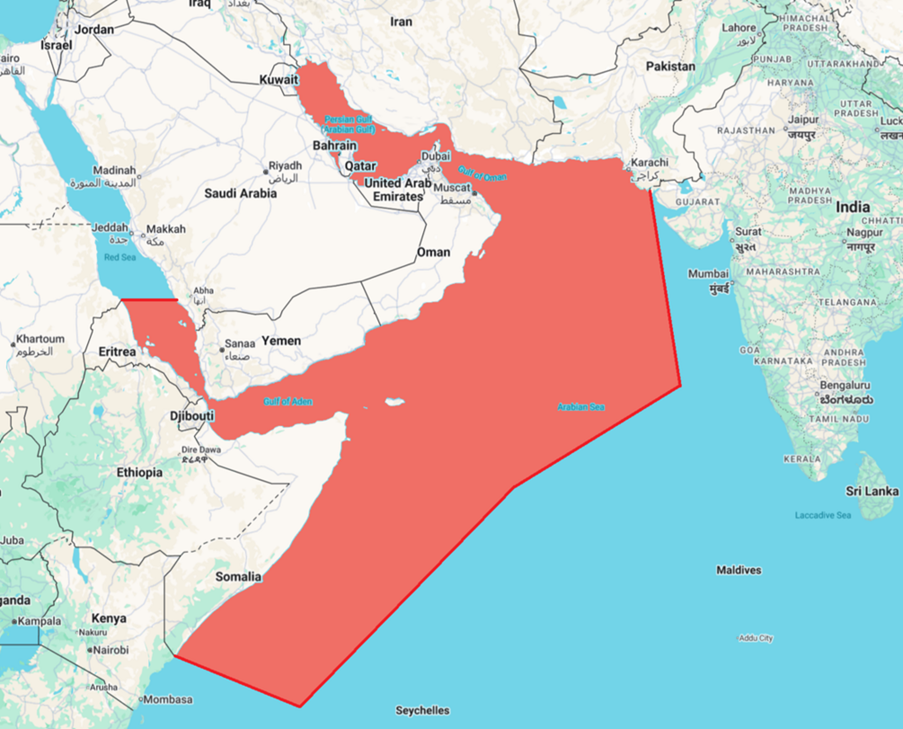
If you have any questions about NTI’s War and Strikes Cover Cancellations, please contact your local NTI representative.
Why reefers and hazardous cargo are often affected first
Reefers and hazardous cargo are typically suspended first because they present higher operational risk for shipping lines and require specialised infrastructure.
If temperature-sensitive cargo suffers physical deterioration during insured transit, for example due to refrigeration failure, cover may respond subject to policy conditions.
Another factor to watch: cargo accumulation
When vessels discharge cargo at intermediate ports, goods can accumulate in a single location. This can mean higher concentrations of insured value, longer storage periods and increased exposure to theft or catastrophe events.
Understanding where cargo is physically located during disrupted voyages becomes increasingly important. Should a customer find themselves with multiple containers offloaded at the same port, or loaded onto the same vessel for onwards transit, it could cause an accumulation of goods which exceeds the policy limit of liability, leaving the customer under-insured. It’s important for customers to monitor the situation and communicate any accumulation to NTI, allowing us update policy conditions and limits to ensure the customer isn’t left out of pocket in the event of an insured incident.
Practical points for brokers
In the current environment, brokers can help cargo owners by encouraging them to:
- Confirm insured values reflect increased freight costs
- Understand how deviation and interim storage are treated under the policy
- Check any storage time limits
- Monitor temperature-sensitive cargo closely
- Notify insurers promptly if voyages change
Early communication can help avoid uncertainty and ensure cover continues as intended.
Remember: NTI is here to help. Contact your local NTI representative today for more information, or you can lodge a claim via our specialist team on 1800 684 669.
Limits and exclusions apply. National Transport Insurance is an equal joint venture administered on behalf of the insurers CGU Australia Pty Ltd trading as CGU Insurance ABN 62 004 478 960 AFSL 700014 and AAI Limited Trading as Vero Insurance ABN 48 005 297 807 AFSL 230859 by its manager NTI Limited ABN 84 000 746 109 AFSL 237246.