


Transport operators are navigating one of the most challenging business environments in recent times, forcing businesses to carefully balance profitability, compliance and long-term sustainability.
Fuel costs, workforce shortages, wage growth and changing customer demands are making it increasingly difficult for operators to maintain margins while continuing to invest in people, equipment and safety.
Against that backdrop, one issue attracting growing attention across the industry is sham contracting.
While the term itself isn't new, industry leaders are concerned about its prevalence and the potential impacts it can have on workers, businesses and the broader transport sector.
So, what is sham contracting, why does it matter, and what should transport businesses and brokers understand about the issue?
What is sham contracting?
Sham contracting can occur when a business represents an employment relationship as an independent contracting arrangement. Whether a worker is legally an employee or a contractor depends on the circumstances of the relationship.
Gary Mahon, CEO of the Queensland Trucking Association (QTA), describes it this way:
“Sham contracting is where an employer fundamentally uses the Tax Act as a veil for employment law. What they're saying is that this person is a contractor and they pay them under what you might call contract conditions. When the reality is that person is an employee.”
In practice, the person may be working regular hours, performing regular tasks, taking direction from a supervisor and working almost exclusively for one business, yet being paid under an ABN rather than employed directly.
While every arrangement is different, the distinction between a genuine contractor and an employee is an important one, particularly when it comes to entitlements, protections and responsibilities.
What can workers miss out on?
One of the key concerns with sham contracting is that workers may unknowingly miss out on (or have different access to) protections and entitlements typically associated with employment.
Depending on the circumstances, these may include:
- Workers' compensation coverage
- Superannuation contributions
- Leave entitlements
- Award conditions
- Other workplace protections and benefits
Many workers are attracted to the prospect of a higher hourly or weekly rate. However, that higher rate may not account for the value of the protections and entitlements they would otherwise receive as an employee.
As Gary says:
“Everything's okay until it's not.”
A workplace injury, vehicle incident or other unexpected event can quickly highlight gaps in coverage and support arrangements that may not have been obvious beforehand.
Some genuine independent contractors in road transport may also have specific rights and protections under the Fair Work Act.
Why are some businesses turning to these arrangements?
The Australian transport industry presents a tough operating environment, and Ross Longmire, CEO of Followmont Transport, says labour remains one of the largest expenses for transport businesses.
“If I look at where our labour falls overall as a business, for transport it will run anywhere between about 25 and 40% of total costs.”
Industry leaders acknowledge there can be strong commercial pressures to reduce operating costs. However, both Gary and Ross are clear that short-term cost advantages can come with significant long-term risks.
“If you can find a way in transport to trim your costs by anywhere between 15 and 25%, that puts you in a really strong market position from a pricing perspective. But we know that's only short-term.”
Ross notes that labour shortages, rising costs and increasing competitive pressures continue to challenge transport businesses across the industry. While those pressures are very real, Ross and other industry leaders agree that sustainable workforce practices remain critical to building resilient businesses and supporting the long-term health of the industry.
Why is sham contracting a risk issue?
For transport businesses and the brokers who support them, sham contracting is about much more than employment arrangements. It can influence safety, compliance, claims outcomes, business resilience and overall risk quality.
Gary points to the potential flow-on effect sham contracting can have on public liability claims and other risk exposures:
“Public liability claims are going through the roof because, like all of these things, everything's okay until it's not.”
Both industry leaders highlighted concerns around:
- Safety performance
- Driver fatigue
- Workforce training
- Vehicle maintenance
- Compliance practices
- Insurance exposures
Ross notes that one concern across the industry is that businesses under increasing pressure may reduce investment in areas such as training, maintenance and compliance. Those decisions can have consequences that extend well beyond immediate cost savings.
A higher-risk operating environment
Transport is a critical part of Australia's economy and supply chain.
Gary believes the growing use of sham contracting is contributing to a higher-risk operating environment across the industry. He warns that the sector could become less sustainable if businesses increasingly compete through unlawful or unsustainable workforce practices.
“We're then moving towards an environment that's much higher risk where you've got people working on what you might call a cash economy, taking shortcuts with safety and provisions within the industry that are normally expected.”
Beyond the impact on individual workers, concerns are heightened around workforce stability, industry professionalism, recruitment challenges and long-term competitiveness. Maintaining strong employment relationships is critical to building a stable workforce, retaining skilled people and creating safer operating environments.
Employee or contractor? A useful test
While every situation is unique, there are practical questions businesses can ask when reviewing workforce arrangements.
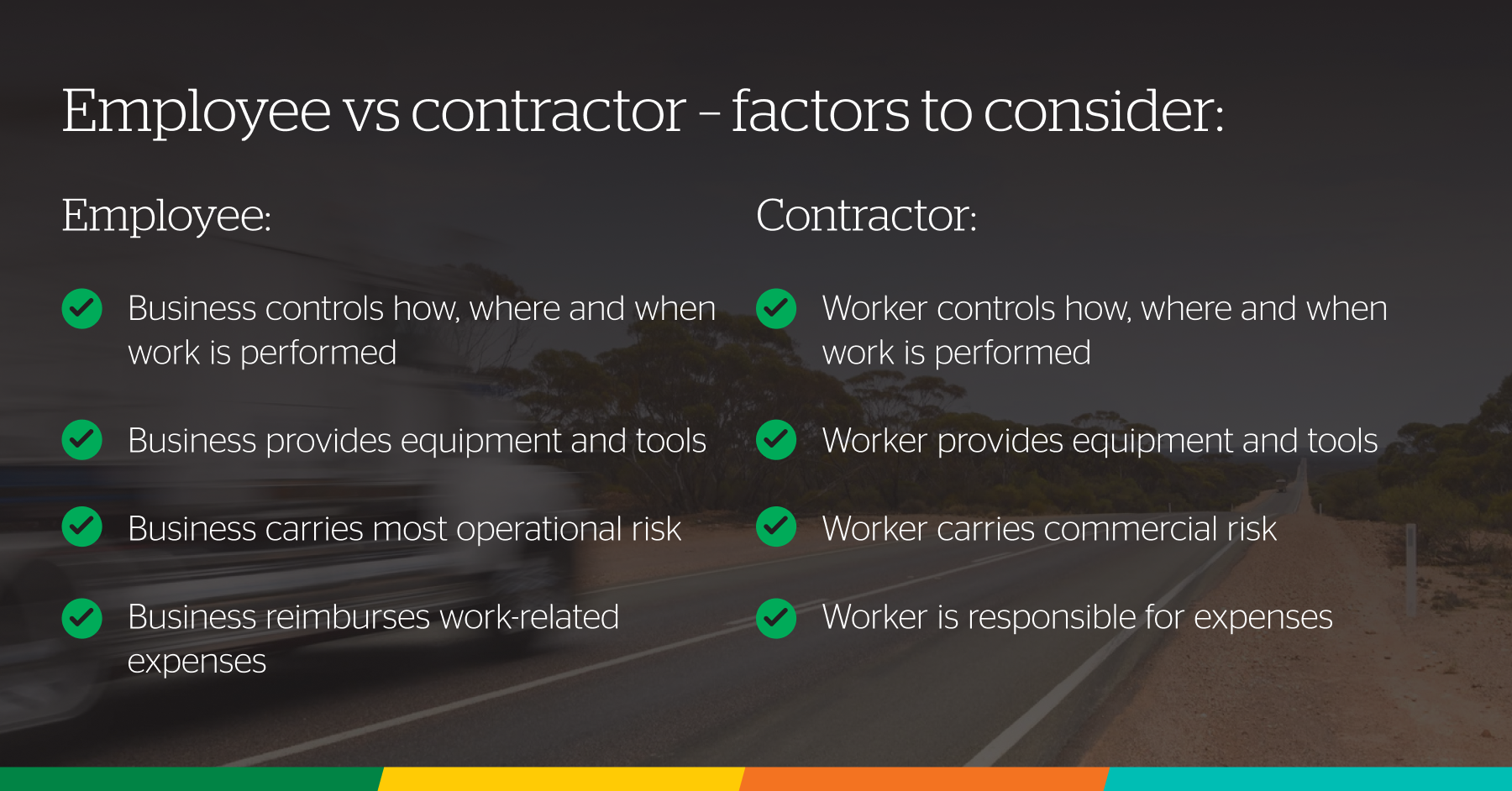
Gary describes the following as a useful "litmus test" when considering whether someone appears to be operating as an employee or a genuine contractor:
- Who controls how, where and when the work is performed?
- Who provides the equipment, tools or vehicles?
- Who carries the financial risk if something goes wrong?
- Who pays for work-related expenses?
Generally speaking, the more control a business has over an individual's day-to-day work, the more likely the arrangement may resemble employment rather than genuine contracting. However, no single factor determines whether a worker is an employee or contractor. The relationship must be considered as a whole.
What does this mean for brokers?
Understanding sham contracting isn't about becoming an employment law expert. For brokers, it's about being aware of an issue that may influence a customer's overall risk profile and business environment.
As transport businesses continue to face labour shortages, rising costs and increasing operational pressures, understanding how a workforce is structured can provide valuable context around broader business risks.
Gary encourages brokers and industry participants to ask questions and seek a better understanding of workforce arrangements.
“We need more and more people asking the right questions when they're assessing customers, when they're assessing who might carry their freight, when they're assessing who might be insured and by how much.”
Importantly, that doesn't mean brokers need to investigate or police employment practices.
As NTI's Jason Rogerson, State Manager – Queensland, highlights, this is ultimately about awareness.
“Understanding the issue can help brokers build a clearer picture of a transport business, the environment it's operating in, and some of the risks it may be managing”.
Looking ahead
Industry bodies, regulators and government agencies are increasingly focused on sham contracting and its impacts on the transport sector. While the issue is complex, one thing is clear: awareness is growing.
For transport businesses, understanding workforce arrangements and the risks associated with them is becoming increasingly important. For brokers, awareness of the issue can provide valuable context when supporting transport and logistics customers.
The more informed the industry is, the better equipped it will be to support safer, more sustainable and more resilient transport businesses into the future.
Want to learn more?
Want to explore the topic further? Watch our on-demand webinar featuring Gary, Ross and Jason as they share their perspectives on sham contracting and its impacts across the transport industry.

Sham contracting: Hidden risks for transport businesses
Featuring special guests from the QTA and Followmont Transport, this webinar explores what sham contracting is, why it persists, and the broader impacts it can have on transport businesses.
FAQs
-
What is sham contracting?
Sham contracting can occur when a business represents an employment relationship as an independent contracting arrangement. Whether a worker is legally an employee or a contractor depends on the circumstances of the relationship.
-
Why is sham contracting a concern in the transport industry?
Sham contracting can affect more than employment arrangements. Industry leaders have raised concerns about impacts on safety, workers' compensation, public liability claims, workforce stability and the long-term sustainability of transport businesses.
-
Why do some transport businesses use contractor arrangements?
The transport industry continues to face rising costs, labour shortages and tight margins. While genuine contractor arrangements play an important role in the industry, concerns arise when workers who function as employees are engaged as contractors instead.
-
How can transport businesses identify potential sham contracting risks?
A good starting point is to review workforce arrangements. Consider who controls the work, who provides the equipment, who carries the financial risk, and whether the worker is genuinely operating an independent business. If you're unsure, seek appropriate legal or employment advice.
-
What should brokers know about sham contracting?
Brokers don't need to become employment law experts. However, understanding workforce arrangements can provide useful context about a customer's operations, risk profile and business environment, helping support more informed conversations with transport businesses.
© 2026 NTI Limited
This article provides general information only and is not legal, financial, employment or other professional advice. You should obtain appropriate advice before relying on it. To the extent permitted by law, NTI accepts no liability for loss arising from reliance on this information.
National Transport Insurance is administered on behalf of the insurers by its manager NTI Limited ABN 84 000 746 109 AFSL 237246.